What Is a Cost-Plus Build — and Why Are So Many People Attracted to It?
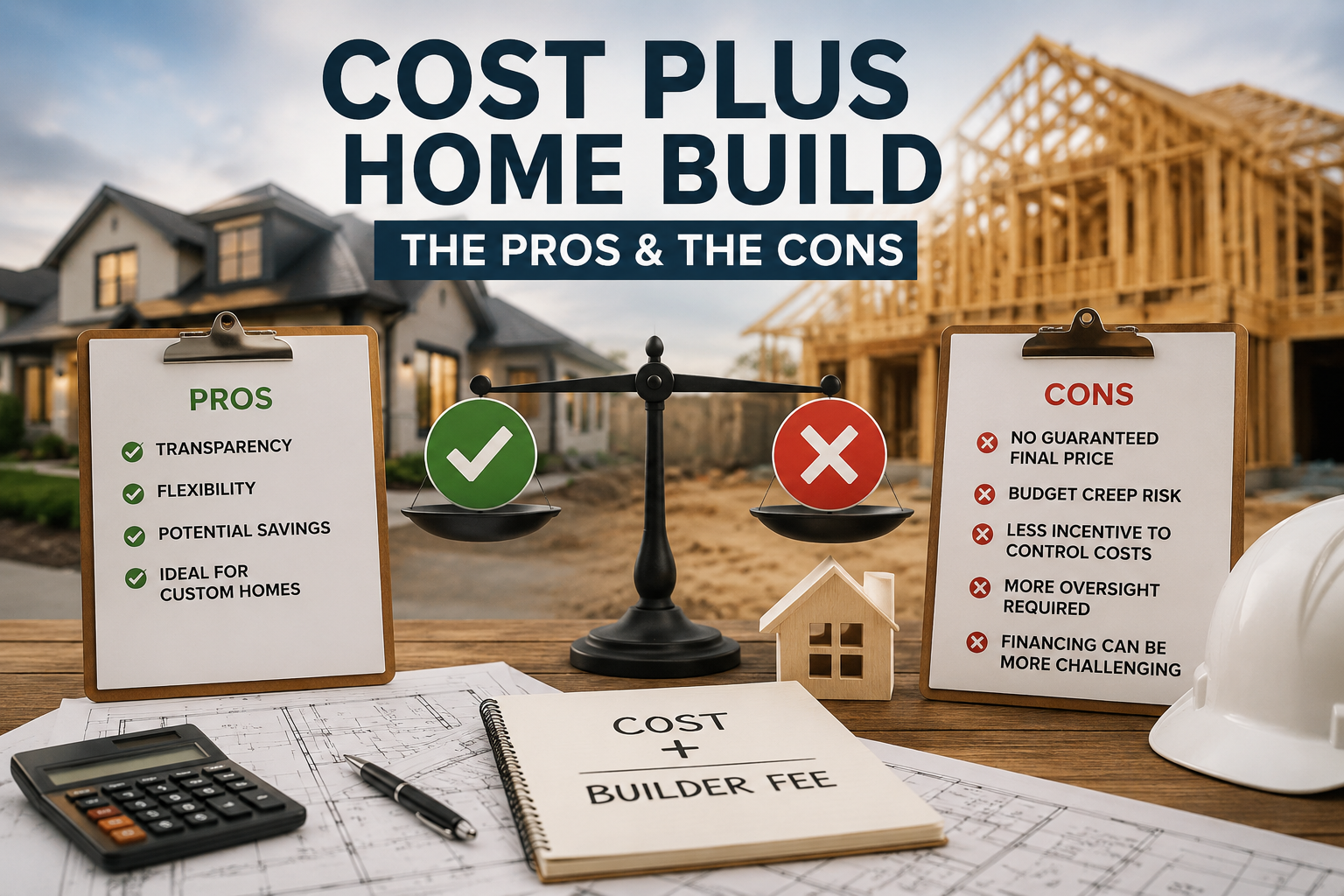
When homeowners start researching custom home construction, the term cost-plus building comes up often. On the surface, it sounds and looks great: you pay the actual cost of materials and labor, plus a fee or percentage for the builder’s profit. No mystery markup, no inflated bids — just real numbers.
It’s an appealing process. The reality of cost-plus construction is far more complicated — and can be far more risky — than most homeowners realize until it’s too late.
If you’re currently weighing a cost-plus contract against a fixed-price build, this guide will walk you through exactly what you need to know.
How Does a Cost-Plus Contract Actually Work?
In a cost-plus agreement, the builder charges you for:
- Direct costs — materials, subcontractor labor, equipment rentals
- Indirect costs — overhead, site supervision, administrative expenses
- Builder’s fee — either a flat fee or a percentage of total costs (typically 10–25%)
Sounds simple. Here’s where it gets complicated.
The 7 Biggest Risks of a Cost-Plus Build
- You Have No Idea What Your Home Will Actually Cost
This is the single biggest problem with cost-plus construction: there is no guaranteed final price.
You might receive an estimate — but an estimate is not a commitment. Material costs fluctuate. Labor takes longer than planned. Scope creep (gradual uncontrolled events) happens. Every unexpected discovery (poor soil conditions, hidden water damage, a supplier backorder, unexpected rock trenching) becomes your financial problem.
Homeowners have found themselves 20%, 30%, even 50% over initial estimates with no legal recourse. If you’re financing your build, this can be catastrophic.
The fixed-price difference: With a fixed-price contract, your builder commits to a number before a single nail is driven. Cost overruns are the builder’s problem to solve — not yours, unless the builder has an escalation clause in their contract.
- Your Builder May Have No Incentive to Work Efficiently
Here’s a hard truth about percentage-based cost-plus contracts: the more your home costs, the more your builder earns.
That creates a misalignment of incentives that no amount of goodwill can fully overcome. A builder earning 15% of total costs makes $15,000 more on a $1,000,000 home than on a $900,000 home. Efficiency doesn’t pay them — spending does.
Even with an honest contractor, the psychological pull of this structure is real. Decisions get made without the same urgency to economize that a fixed-price builder has baked into every line item.
The fixed-price difference: A fixed-price builder’s profit depends entirely on finishing your home on budget. They have every incentive to plan carefully, source smartly, and execute efficiently.
- You Become a Part-Time Auditor
Cost-plus contracts require you to review and approve invoices, receipts, and timesheets — often on a weekly or biweekly basis. Unless you have a background in construction accounting, this is both exhausting and easy to get wrong.
Common issues homeowners face:
- Materials purchased for other job sites billed to your project
- Labor hours padded or miscounted
- Overhead charges that are vague or duplicated
- Subcontractor invoices marked up without disclosure
Catching these issues requires time, expertise, and a willingness to question your builder — which can damage the working relationship you depend on for the next 12–18 months.
The fixed-price difference: You review a contract once, agree on a price, and focus your energy on the fun parts — finishes, fixtures, and watching your home come to life.
- Financing Becomes Much Harder
Banks and lenders are cautious about cost-plus construction loans for one simple reason: they can’t assess the risk without knowing the final number.
Construction lenders typically want to see a fixed contract price before approving your loan. With a cost-plus agreement, you may face:
- Higher interest rates to offset lender uncertainty
- Lower loan-to-value approvals
- Difficulty qualifying at all
- The need for larger cash reserves as a cushion
If your budget is already stretched — as most custom home budgets are — this added financial friction can derail your project before it begins.
The fixed-price difference: A fixed-price contract gives lenders exactly the certainty they need. Approvals are smoother, terms are often better, and your financial plan holds together.
- Disputes Are Common and Costly
When the final bill comes in significantly higher than the estimate, emotions run high. Homeowners feel misled. Builders feel unfairly blamed. Arguments over what was and wasn’t agreed to become difficult to resolve — especially when the paper trail is a pile of invoices rather than a signed contract.
Construction disputes are expensive, time-consuming, and emotionally draining. Even when you “win,” you lose — in time, stress, and legal fees.
The fixed-price difference: A well-written fixed-price contract defines scope, allowances, and change order procedures clearly. Everyone knows the rules before the game starts.
- Scope Creep Is Nearly Invisible
In a cost-plus environment, small decisions add up without you realizing it. A slight upgrade here, an extra electrical outlet there, a small design change that required re-framing — each item seems minor. Together, they can add tens of thousands of dollars to your final invoice.
Because there’s no hard ceiling, there’s no moment that forces a serious conversation about value versus cost.
The fixed-price difference: Every change to scope goes through a formal change order with a defined cost. You always know exactly what you’re agreeing to before work begins.
- Your Stress Level Will Be Higher — for Longer
Building a home is already one of the most stressful experiences a family can go through. A cost-plus contract amplifies that stress by adding financial uncertainty to every phase of the project.
Will this month’s draw be higher than expected? Is the framing taking longer than it should? Why did lumber costs go up this week? These are questions you should not have to carry.
So Who Is Cost-Plus Actually Right For?
To be fair, cost-plus contracts aren’t always the wrong choice. They can make sense when:
- The project scope is genuinely unknowable upfront (major historical restorations, for example)
- You have construction expertise and the bandwidth to audit invoices regularly
- You have deep trust in your builder and access to open-book accounting
- You have significant financial reserves to absorb overruns
For most families building a custom home, none of those conditions apply.
What to Look for in a Fixed-Price Builder
If a fixed-price contract sounds more like what you need, here’s what to look for when evaluating builders:
- Detailed, itemized contracts — vague contracts are a red flag regardless of pricing structure
- Transparent allowances — make sure fixture, flooring, and finish allowances are realistic
- Clear change order process — understand exactly how scope changes will be priced
- Strong subcontractor relationships — builders with established trade partners have more pricing stability
The Bottom Line
A cost-plus contract might feel like you’re getting transparency, but what you’re really getting is transferred risk — risk that would typically be on a builder’s plate, handed back to you.
A fixed-price build puts the accountability where it belongs: on the professionals who know how to manage it. You get a clear number, a binding commitment, and the peace of mind to actually enjoy the process of building your home.
Ready to explore what a fixed-price custom home could look like for you? Contact us today for a no-obligation consultation.