Why Does a One-Story Home Cost More to Build Than a Two-Story Home?
If you’ve ever compared pricing between a one-story and a two-story home, you may have noticed something surprising:
👉 A 3,000 sq ft one-story home can cost MORE to build than a 3,500 sq ft two-story home.
At first glance, that doesn’t seem to make sense.
But once you understand how homes are actually built, the reason becomes clear—and it all comes down to efficiency of construction and footprint size.
The Real Cost Driver: The Home’s Footprint
The biggest difference between a one-story and two-story home isn’t just square footage—it’s how that square footage is distributed.
- A one-story home spreads everything across the ground
- A two-story home stacks square footage vertically
That difference has a major impact on cost.
1. Foundation Costs: Bigger Footprint = Higher Cost
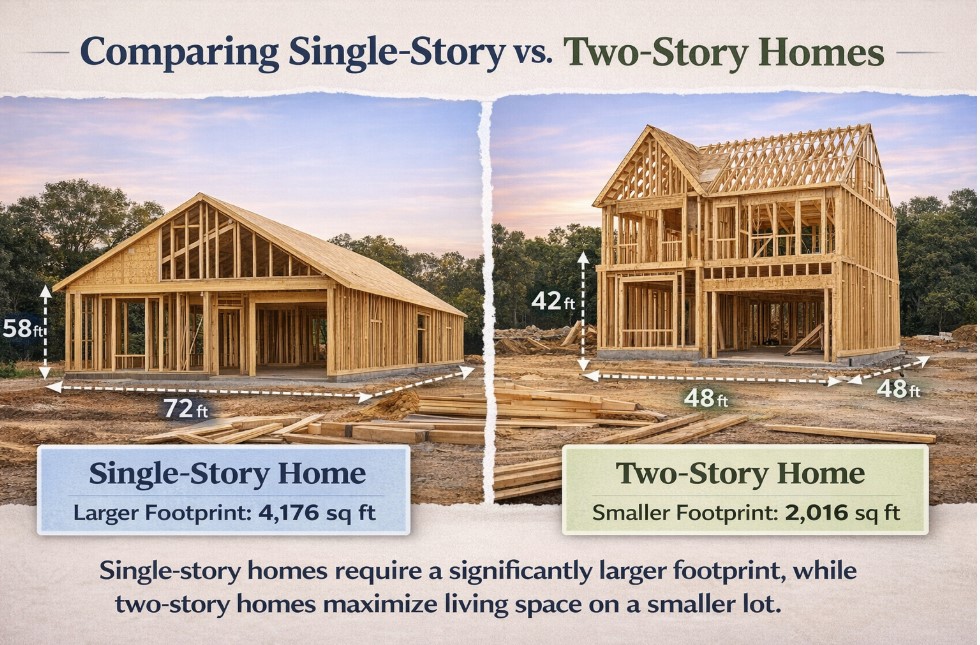
A one-story home requires a much larger foundation because all the living space sits on the ground level.
That means:
- More concrete
- More excavation
- More labor
- More reinforcement
A two-story home, on the other hand, cuts the foundation footprint significantly—sometimes nearly in half.
👉 Less foundation = immediate cost savings
2. Roofing Costs: One of the Most Expensive Components
Roofing is one of the most expensive parts of building a home.
With a one-story home:
- The roof must cover the entire 3,000 sq ft footprint
- More trusses, decking, shingles, and labor are required
With a two-story home:
- The roof only covers the smaller upper footprint
- You get more square footage without doubling roofing costs
👉 You’re getting more house under less roof
3. Exterior Wall Costs Add Up Quickly
A larger footprint means more perimeter—and more perimeter means more cost.
A one-story home requires:
- More brick or siding
- More insulation
- More windows and framing
A two-story home reduces the total exterior wall area needed per square foot.
👉 Exterior finishes are expensive—this is a big factor buyers don’t always see.
4. Mechanical Systems & Utility Runs
In a one-story home:
- Plumbing lines run farther
- HVAC ductwork stretches wider
- Electrical runs are longer
That increases both material and labor costs.
In a two-story home:
- Systems are more compact and vertically stacked
- Runs are shorter and more efficient
👉 Efficiency behind the walls = savings in the build
5. Why the Second Floor Is Cheaper Per Square Foot
Here’s a key insight most buyers don’t realize:
👉 The second floor is typically cheaper to build than the first floor.
Why?
Because it doesn’t require:
- Another foundation
- Another roof system
You’re mainly adding:
- Framing
- Flooring system
- Drywall and finishes
That’s why builders can often add 500+ sq ft upstairs at a lower cost than adding that same space on the ground level.
6. Why Builders Often Recommend Two-Story Homes
From a builder’s perspective, two-story homes provide:
- Better cost efficiency
- More square footage for the price
- Greater scalability in design
- Higher value perception for buyers
This is why you’ll often see more two-story homes in newer developments—they simply make financial sense.
When Does a One-Story Home Still Make Sense?
Even though one-story homes can cost more per square foot, they are still incredibly desirable.
Buyers may prefer a one-story for:
- Aging in place / accessibility
- No stairs for young kids or elderly family members
- Open, spread-out layouts
- Luxury home designs
In fact, many high-end custom homes are one-story specifically because of the lifestyle they provide.
Final Takeaway
If you remember one thing, let it be this:
Building out costs more. Building up creates efficiency.
A one-story home requires more:
- Foundation
- Roofing
- Exterior materials
- Labor
While a two-story home allows you to:
- Maximize square footage
- Reduce structural costs
- Improve overall efficiency
Thinking About Building in Middle Tennessee?
At Michael’s Homes, we walk buyers through these decisions every day—helping you balance budget, design, and long-term lifestyle.
Whether you’re building on your lot or ours, we’ll help you understand:
- Where your money is going
- How to maximize your investment
- What design fits your long-term goals